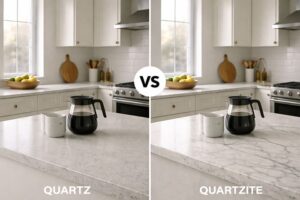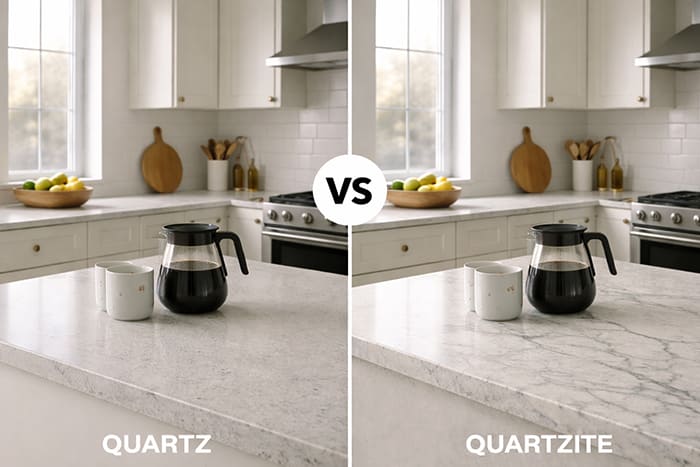
Quartz vs. quartzite countertops is one of the most common questions we hear from clients. Although the names sound similar, these materials differ significantly in composition, performance, and maintenance. Understanding these distinctions is essential when selecting the right surface for your space.
With over 20 years of experience guiding both residential and commercial clients, we know that an informed choice makes all the difference. Therefore, let’s clearly break down how quartz and quartzite compare, so you can choose the countertop that best fits your kitchen with confidence.
Quartz Vs Quartzite Countertops: Key Differences Explained
Quartz Countertops: Engineered Surfaces with Versatility
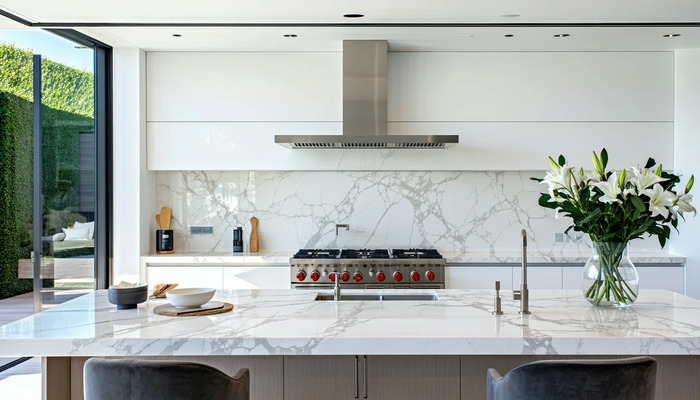
Quartz countertops, also known as engineered surfaces, are manufactured in controlled factory environments. During production, crushed quartz crystals—typically 90–95%—are combined with polymer resins and pigments to form a smooth, non-porous slab.
As a result, quartz countertops offer consistent patterns, exceptional durability, and low maintenance. Their clean appearance, design versatility, and resistance to stains and bacteria make them a popular choice for modern kitchens and bathrooms.
Quartzite countertops are made from 100% natural stone. Over millions of years, sandstone rich in quartz transforms under intense heat and pressure, forming a dense metamorphic rock. In contrast, quartz is an engineered material made from crushed quartz and resin. As a result, quartzite offers the authentic beauty and natural strength many homeowners value.
Despite their differences, both materials remain popular for their durability and visual appeal. Below, we compare quartz and quartzite in terms of durability, appearance, maintenance, cost, and ideal applications to help you choose confidently.
Durability and Care
Durability and Hardness
Both quartz and quartzite countertops are highly durable, but they excel in different ways. As two of the most popular countertop materials, each offers exceptional strength and long-lasting performance, making them reliable choices for modern homes.
Quartz Countertops (Engineered Stone):
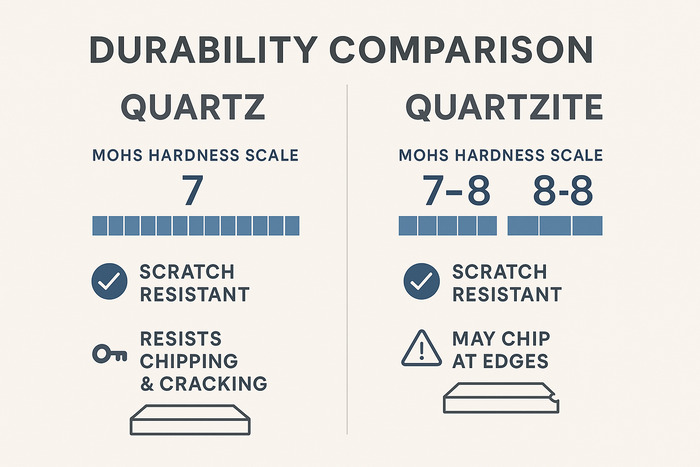
- Rank around 7 on the Mohs hardness scale (with 10 as diamond)
- Offer high scratch resistance for everyday use
- Resist scratching, chipping, and cracking under normal conditions
- Include resin that adds slight flexibility, which helps reduce edge chipping
Quartzite Countertops (Natural Stone):
- Rank between 7 and 8 on the Mohs hardness scale
- Provide exceptional scratch resistance when properly sealed
- Withstand heavy wear due to their dense, natural composition
- May chip if subjected to a strong impact along the edges
When it comes to durability, both quartz and quartzite perform exceptionally well. Each material provides a strong, reliable surface suitable for heavy use in kitchens and bathrooms.
Ultimately, when comparing quartzite vs. quartz countertops, durability is not the deciding factor. Instead, the right choice depends on your lifestyle, design preferences, and maintenance expectations.
Quartz Vs Quartzite Countertops for Heat and Stain Resistance
Heat Resistance
Quartzite Countertops (Natural Stone):
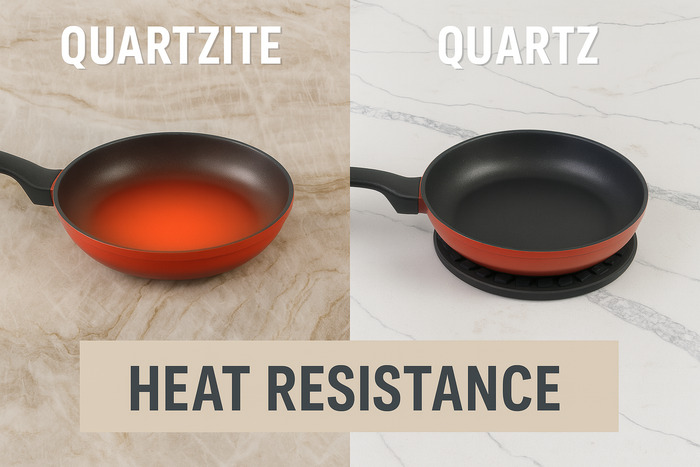
- Naturally heat resistant due to their formation under intense heat and pressure
- Withstand high temperatures without damage
- Safely accommodate hot pans placed directly on the surface
Quartz Countertops (Engineered Stone):
- Manufactured with natural quartz and resin binders
- Although quartz is heat resistant, the resin can soften around 300°F
- Direct contact with extremely hot cookware may cause scorching or burn marks
- Therefore, using trivets or hot pads is recommended for daily protection
Summary
- When comparing heat resistance, natural quartzite outperforms quartz.
- Quartz countertops tolerate everyday cooking heat but remain vulnerable to extreme temperatures.
- Therefore, quartz is not suitable for fireplaces or high-heat areas; natural stone like quartzite is the better option.
Stain and Moisture Resistance
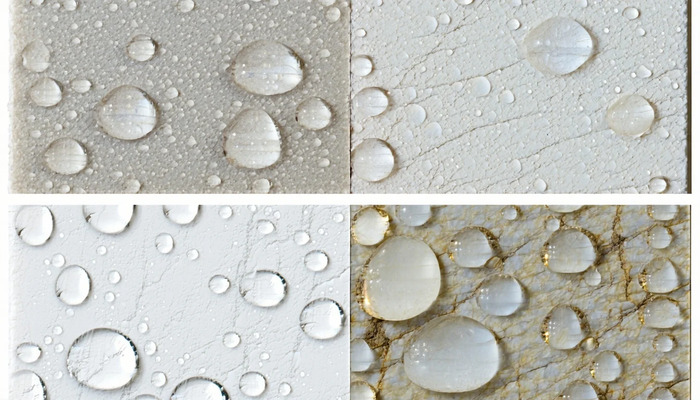
Quartz offers a clear advantage in stain and moisture resistance. Because it has a non-porous surface, it does not absorb liquids, making it naturally stain resistant and easy to clean. In addition, it requires no sealing, and spills such as wine or oil wipe away without leaving marks.
By contrast, quartzite is a natural stone with some porosity, so regular sealing is necessary to prevent liquids from penetrating the surface. However, when properly sealed, quartzite resists stains and moisture effectively. Cleaning is straightforward—use a stone-safe cleaner and reseal the surface when water no longer beads.
Ultimately, both materials perform well with proper care. Avoid abrasive cleaners to protect the finish, and maintain sealing as needed. Many homeowners choose quartzite for its natural beauty and strength, even with the added step of occasional sealing.
Appearance and Style Options
Quartzite countertops offer a distinctive natural beauty that appeals to many homeowners. They resemble marble’s elegant veining and soft color transitions, yet deliver the strength and durability of granite.
Moreover, quartzite is tougher and more scratch resistant than marble. Unlike marble, it does not etch when exposed to acidic substances such as lemon juice or vinegar. As a result, quartzite is an excellent choice for those who want marble-like elegance without the intensive maintenance.
Each quartzite slab is unique. Colors range from white and gray to beige, gold, and even subtle hints of blue or pink, depending on mineral composition. Overall, quartzite offers a lighter, airier look with more movement than granite.
Finally, many slabs feature a polished finish and striking natural patterns, creating a refined, high-end appearance. For kitchen countertops that make a statement, quartzite delivers lasting beauty and character.
Design and Performance
Quartz – Endless Design Possibilities
As one of the most popular engineered surfaces, quartz delivers consistent color and pattern across large areas. Because it is man-made, quartz offers far greater control over design than natural stone.
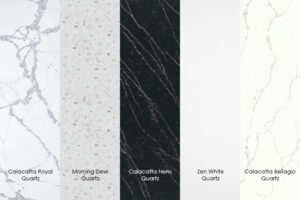
During manufacturing, pigments are added to produce a wide range of shades, from bright white and jet black to navy blue, warm taupe, and bold red. In addition, quartz can be engineered to replicate the look of marble or granite while maintaining uniformity from slab to slab.
As a result, quartz is an excellent choice for clean, modern designs or large spaces that require a cohesive look. At Granite Granite Inc., we work with all major quartz brands and suppliers, allowing us to source virtually any color or style you prefer.
However, not all quartz products are created equal. Lower-cost options may discolor over time or show wear more quickly. Our team helps you select a high-quality quartz that delivers both lasting beauty and long-term performance.
Maintenance and Longevity
Maintenance and Cleaning
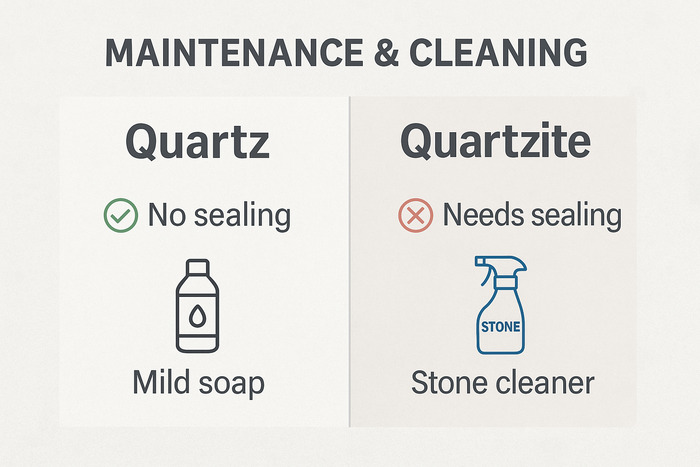
Quartz is one of the easiest countertop materials to maintain. Because it is non-porous, it never requires sealing and naturally resists stains from everyday spills. Cleaning is straightforward—use mild soap and warm water or a gentle household cleaner. Avoid abrasive pads or harsh chemicals, as they can dull the surface over time. Overall, quartz remains one of the lowest-maintenance options available.
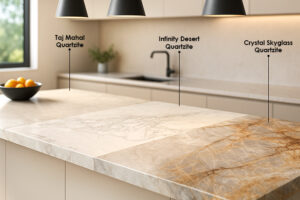
In contrast, quartzite is a natural stone and therefore more porous than quartz; however, porosity varies by type. Some dense varieties, such as Taj Mahal and Cristallo, absorb very little moisture and may rarely need sealing. For this reason, it’s important not to generalize. A simple test helps determine when resealing is necessary: if water darkens the surface after sitting briefly, the stone is absorbing liquid and needs sealing.
Fortunately, sealing quartzite is easy. Apply the sealer, allow it to absorb, and wipe off the excess. For daily care, clean quartzite with a pH-neutral stone cleaner and avoid acidic or abrasive products.
It’s also important to note that not every slab sold as quartzite is truly quartzite. Some stones, particularly certain Brazilian marbles, are mislabeled and will etch when exposed to acids. To test, place a small amount of lemon juice or vinegar on the surface for a few minutes. If it leaves a dull mark, the stone is marble not quartzite. If you’re ever unsure, our team is always happy to help you identify the material.
Finish Options
Both quartz and quartzite are available in a variety of finishes beyond the traditional polished look. If you prefer a softer, more natural appearance, a honed finish delivers a smooth, matte surface. For added texture and a more organic feel, a leathered finish is an excellent option and also helps conceal smudges and fingerprints.
Fabrication Matters (Especially for Quartzite):
That’s why working with a trusted local fabricator is especially important for quartzite. This is not a material for inexperienced handling.
Proper fabrication requires advanced tools such as CNC machines, waterjet cutting, and, most importantly, skilled expertise to manage fine details accurately. Without the right approach, mistakes can lead to breakage and material waste, significantly increasing the cost per square foot. When working with premium stone, maximizing yield is essential to control overall project cost.
Best Application and Uses
Choosing between quartz and quartzite depends on your lifestyle, design goals, and where the countertop will be installed. Both materials are durable and visually striking, but each excels in different applications.
Quartz is ideal for high-traffic kitchens and busy bathrooms where low maintenance matters most. It is non-porous, stain resistant, and easy to clean, making it a favorite for families and frequent cooks. However, it is not recommended for outdoor use or fireplace surrounds due to heat and UV sensitivity.
Quartzite, on the other hand, suits homeowners who love to cook and want a surface that easily handles hot pans. Its natural strength and distinctive veining make it perfect for statement applications such as large islands, waterfall edges, and outdoor kitchens. With occasional sealing, quartzite delivers the elegance of marble with far greater durability.
Finally, consider other natural stones such as soapstone or marble, each offering its own look, performance, and maintenance profile. If you are unsure, we are happy to guide you through the options and help you find the best fit for your space.
In Nutshell – Which Should You Choose?
When it comes to choosing between quartz vs quartzite countertops, both are excellent materials. The right choice ultimately depends on your priorities and how you use your space.
Quartz is ideal if you want a low-maintenance surface with consistent color and a variety of price options. It is durable, stain-resistant, and perfect for busy kitchens and bathrooms where ease of use matters most.
Quartzite, on the other hand, offers the natural elegance of marble with the strength of granite. It is perfect for statement islands, heat-intensive cooking areas, and even outdoor spaces. Natural quartzite provides lasting beauty, durability, and long-term value.
Still unsure which material suits your home? Visit our Granite Granite Inc. showroom at 10410 Hempstead Rd, Houston, Texas. We also serve customers through seven distribution centers in Corpus Christi, El Paso, Dallas, Shreveport, Albuquerque, and Tucson.
Frequently Asked Questions
- What is the difference between quartz and quartzite?
Quartz is an engineered surface made by combining 90–95% crushed quartz with resin and pigments. Quartzite, in contrast, is a 100% natural stone formed when sandstone undergoes intense heat and pressure over millions of years.
- Is quartzite more expensive than quartz?
Generally, yes. Quartzite typically costs $80–150+ per square foot installed, while quartz ranges from $50–150 per square foot. High-end quartz can match mid-range quartzite prices, reducing the cost difference at premium levels.
- Quartz or Quartzite is better for heat resistance?
Quartzite outperforms quartz in heat resistance. It can handle hot pans directly from the oven, while quartz may scorch above 300°F due to its resin content. For frequent cooking with high heat, quartzite is the safer choice.
- Do quartzite countertops need sealing?
Most quartzite surfaces require periodic sealing, usually annually or biannually, to prevent stains. Dense varieties like Taj Mahal and Cristallo may rarely need sealing. Test by placing water on the surface: if it beads, the seal is effective; if it darkens the stone, it’s time to reseal.
- Which is more durable: quartz or quartzite?
Both materials are highly durable, rating 7–8 on the Mohs hardness scale. Quartzite is slightly harder and more heat resistant, while quartz’s resin content makes it less prone to chipping. Both are excellent long-term choices for kitchens and bathrooms.
- Which is better: quartz or quartzite?
It depends on your priorities. Choose quartz for low-maintenance, consistent surfaces ideal for busy kitchens. Choose quartzite for natural beauty, heat resistance, and a marble-like appearance with granite’s strength. Both are excellent long-term investments for your home.