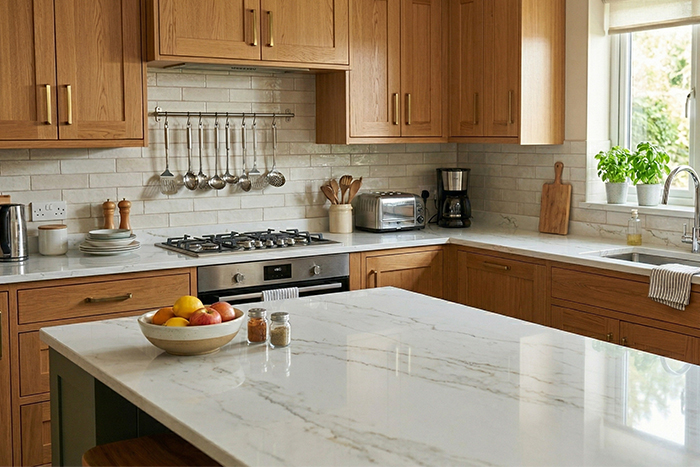
Are you searching for the granite wholesale suppliers for your home? Every day, homeowners visit countertop stores, admiring stunning slabs and imagining how they’ll transform their spaces. Yet many don’t realize that granite varies greatly in quality. Some stones endure for decades, growing richer and more beautiful with age. Other’s crack, stain, or fade within a few years. Knowing how to distinguish high-quality granite from inferior options protects your investment.
So, how can you tell the difference? Let’s explore five proven methods to help you identify premium stone every time.
Granite Wholesale Suppliers with Premium Stone Selection
- The First Look – What Your Vision Reveals
Start with what you can see. High-quality granite reveals itself through consistent patterns and rich depth. Step closer to the slab and check for even color distribution. Natural stone should show variation, but extreme shifts or muddy patches often indicate lower grades.
Next, examine the color. Vibrant, clear tones suggest durability, while dull or flat shades point to poorer quality. Premium slabs display depth, with visible layers of minerals that add dimension. It’s like gazing into a forest rather than looking at a flat photograph.
Would you like me to continue polishing the rest of your draft in the same style so the entire piece flows seamlessly?
How Does Surface Texture Indicate Granite Quality?
Now check the texture. Run your hand across the surface. Quality granite feels smooth and even, without rough spots or pitting. Small fissures are natural and add character but avoid slabs with visible cracks or chipped edges.
Also, watch for defects. Hairline fractures, especially near corners, often worsen over time. Consistent thickness across the slab, as Houzz notes, reflects higher manufacturing standards and greater durability.
Granite Wholesale Suppliers for Quality Stone Solutions
- The Splash Test – A Simple Way to Measure Granite’s Absorption Rate
Here’s a simple test you can try at the countertop shop: pour a small amount of water on the surface. Quality granite repels moisture instead of absorbing it.
Testing Water Absorption
This test reveals the stone’s porosity—the number of tiny holes in the material. Less porous granite resists bacteria, stains, and moisture. Watch for five to ten minutes. If the water beads up, that’s ideal. If it spreads or darkens the stone, that’s a warning sign.
High-quality granite usually has absorption rates below 0.4%. Ask your fabricator for official test results to confirm the stone’s performance.
You can also detect artificial coloring this way. If water causes the color to bleed or fade, the slab may have been dyed or treated with low-quality resins.
Natural granite maintains its color integrity when wet.
- Wear and Tear – Testing Your Countertop’s Toughness
Granite ranks high on the Mohs hardness scale, which measures resistance to scratching. Quality stone withstands everyday use without visible damage.
Try this simple test: use a coin or key to gently scrape an inconspicuous spot. True granite won’t scratch. If marks appear, the slab may be a softer stone marketed as granite or a lower-grade material that won’t last in a kitchen.
Scratch resistance is especially important for countertops, where food prep, dishes, and daily activity put surfaces to the test. According to study, premium granite resists scratches from steel knives, though cutting directly on stone is discouraged to protect your knives.
Finally, ask your installer about the slab’s hardness rating. They should know the technical specifications and be willing to demonstrate the stone’s durability.
- Tone and Texture – Using Sound to Confirm Granite Grade
Acoustics can reveal a lot about stone integrity. Tap the surface with your knuckles in several spots. Quality granite produces a clear, ringing tone, almost like glass.
In contrast, dull or thudding sounds suggest problems. Internal cracks, excessive resin, or weak structure often create that hollow effect. It’s similar to tapping a watermelon for ripeness—except here, you’re checking for density and strength.
- Know Your Source: Why Origin Papers Matter for Quality
Always ask about the stone’s origin. Where was it quarried? Reliable suppliers provide detailed information, including the specific quarry and country.
Granite Certifications – Look for documentation on:
- Absorption rates
- Flexural strength
- Density measurements
- Radioactivity levels
- Polish retention
Reputable stores maintain these records and share them openly. If a supplier avoids the topic, consider it a warning sign.
Next, check the weight. Denser granite performs better and typically weighs about 18 pounds per square foot at 3 cm thickness. Lighter slabs may signal inferior material or excessive resin.
Understanding certifications ensures smarter remodeling decisions. You’ll rely on verified facts rather than sales pitches.
In Nutshell
Now you have the tools to evaluate granite like a pro. Quality stone is a long-term investment, and taking time to assess each slab protects both your budget and your vision.
Great granite combines beauty with performance—you shouldn’t have to sacrifice one for the other. Trust your observations, ask questions, and walk away from anything that raises doubts.
Ready to choose the perfect stone for your home? Granite Granite Inc brings years of expertise in helping homeowners select and install premium natural stone.
Our team guides you through every step, from selection to installation. Contact us today for a free consultation, and let’s find the granite wholesale suppliers that will bring your kitchen dreams to life.
Frequently Asked Questions:
- How can I tell if granite is good quality?
You can assess granite quality by checking its density, thickness, finish, and porosity. High-quality granite feels heavy, has a uniform polish, and resists water absorption. Additionally, inspect for natural patterns rather than overly repetitive designs.
- Does thicker granite mean better quality?
Not always, but it is a strong indicator. Thicker slabs (typically 18–20 mm) offer better durability and longevity. However, even thinner granite can perform well if it has high density and proper reinforcement.
- How do I check if granite is porous?
Simply pour a few drops of water on the surface. If the water absorbs quickly and darkens the stone, the granite is more porous. High-quality granite absorbs slowly, indicating better resistance to stains and moisture.
- Is uniform color a sign of premium granite?
This is a common misconception. Natural granite typically has variations and unique veining. Perfectly uniform patterns may indicate lower-grade stone or engineered alternatives rather than premium natural granite.
- Can I scratch granite easily?
No, high-quality granite is highly scratch-resistant. You can test it by lightly scratching with a metal object. If it scratches easily, it may be a lower-grade stone or improperly treated surface.
- What is the importance of granite polishing quality?
Polishing directly affects both appearance and performance. A high-quality polish enhances shine, improves stain resistance, and protects the surface. Poor polishing can make granite look dull and more prone to damage.
- Are all granite slabs sealed before purchase?
Not always. Some suppliers pre-seal granite, while others do not. It is essential to confirm this, as sealing protects against stains and moisture. If not sealed, you should apply a sealant after installation.
- Does price always reflect granite quality?
No, price can vary due to rarity, origin, and transportation costs. While premium granite often costs more, you should evaluate physical properties like density, finish, and durability rather than relying on price alone.
- How can I identify cracks or weak spots in granite?
Inspect the slab under good lighting. Look for visible cracks, fissures, or resin-filled areas. While minor fissures are natural, large cracks or excessive fillers may weaken the stone over time.
- Is imported granite better than local granite?
Not necessarily. Both imported and locally sourced granite can offer excellent quality. The key is to evaluate the slab based on durability, finish, and porosity rather than origin alone.